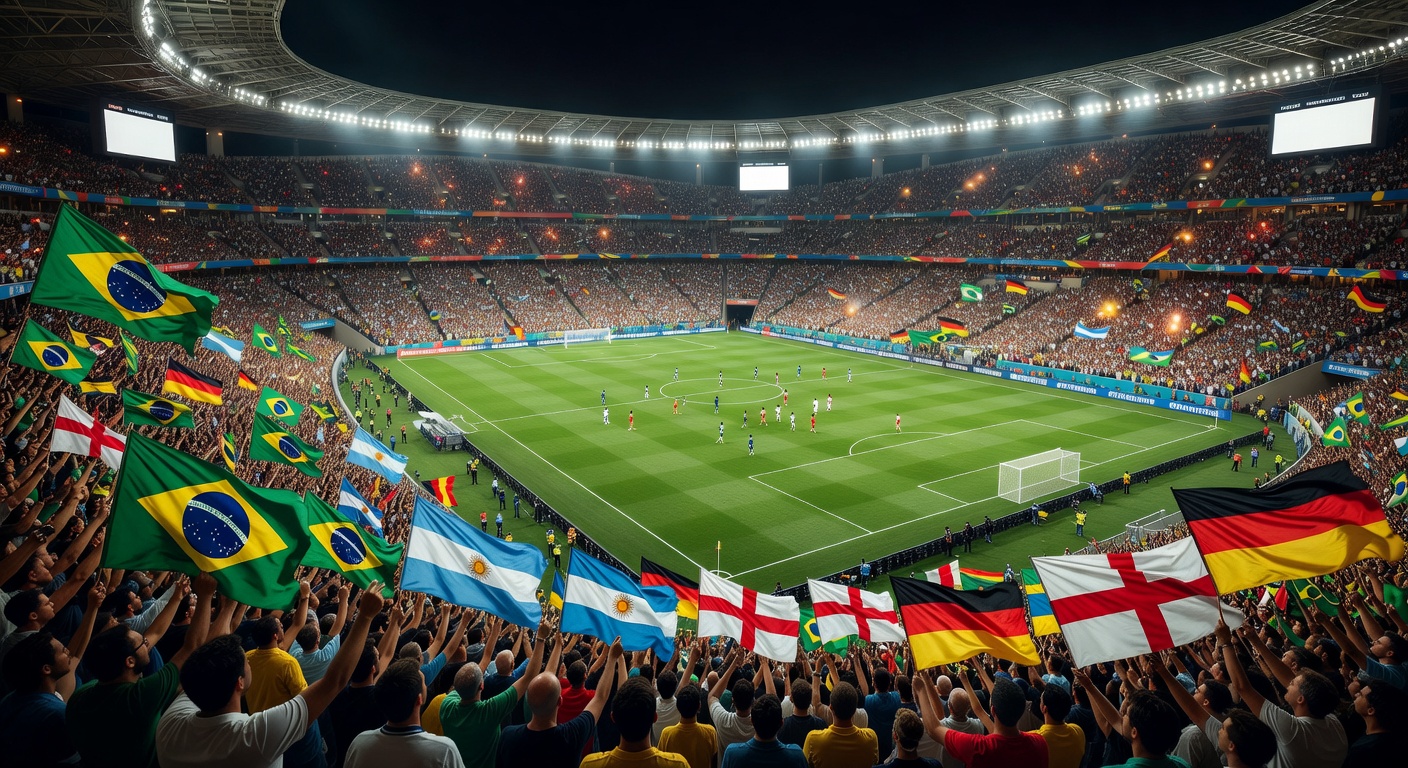
The 2026 FIFA World Cup spans 16 host cities across three countries — 11 in the United States, 3 in Mexico, and 2 in Canada. Climate, altitude, and travel distance will play a bigger role than ever before. Here's the complete breakdown.
🇺🇸 United States — 11 Host Cities
The United States hosts 60 matches across 11 venues, stretching from the East Coast to the West Coast. Conditions vary dramatically — from the coastal humidity of Miami and Philadelphia to the dry heat of Dallas and Houston, the coastal mild of Seattle and the Bay Area, and the altitude of Denver-adjacent venues.
🏟️ MetLife Stadium (New York/New Jersey)
Capacity: 82,500. Hosts the Final on 19 July 2026. The most important venue of the tournament.
🏟️ SoFi Stadium (Los Angeles)
Capacity: 70,000. State-of-the-art indoor venue. Climate-controlled conditions favor technical teams.
🏟️ AT&T Stadium (Dallas)
Capacity: 80,000. Retractable roof. Texas summer heat is a major factor for outdoor matches.
🏟️ Mercedes-Benz Stadium (Atlanta)
Capacity: 71,000. Indoor venue. Atlanta's heat neutralized by climate control.
 Venue conditions will play a decisive role in the 2026 tournament
🇲🇽 Mexico — 3 Host Cities
Mexico hosts 13 matches across three iconic venues. Altitude is the defining factor here: Mexico City's Estadio Azteca sits at 2,240 meters above sea level — enough to significantly impact endurance and ball flight.
🏟️ Estadio Azteca (Mexico City)
Capacity: 87,000. Hosts the opening match on 11 June 2026. The only stadium to host three World Cup tournaments (1970, 1986, 2026).
🏟️ Estadio Akron (Guadalajara)
Capacity: 49,000. Elevation around 1,550 meters. Warm, dry conditions typical of the region.
🏟️ Estadio BBVA (Monterrey)
Capacity: 53,000. Hot, dry summer conditions. Favors physically conditioned squads.
🇨🇦 Canada — 2 Host Cities
Canada hosts 13 matches across two cities. Both offer mild summer conditions — a welcome respite from the heat elsewhere — and unique atmospheric qualities.
🏟️ BMO Field (Toronto)
Capacity: 45,000 (expanded for World Cup). Mild summer conditions. Atmospheric venue for Canadian home matches.
🏟️ BC Place (Vancouver)
Capacity: 54,500. Indoor retractable-roof venue. Predictable conditions favor technical football.
Who Benefits Most From the Conditions?
Teams with the deepest squads and best fitness conditioning will benefit most from the tournament's geographic spread. Historically, physically dominant nations — Germany, England, the Netherlands — struggle in extreme heat. Meanwhile, teams accustomed to heat and altitude — Mexico, Brazil, Colombia — gain natural advantages in specific venues.
The host nations obviously benefit from home support and familiarity with conditions. Mexico at Azteca is particularly formidable. The USA has the crowd advantage across 11 venues but lacks the elite squad quality to fully capitalize.
Final Verdict
The 2026 World Cup will be the most condition-sensitive tournament in history. Managers who can rotate squads intelligently, adapt to 16 different venues, and prepare physically for extreme variation will have a decisive edge. For the first time, logistics and sports science may matter as much as tactics.